
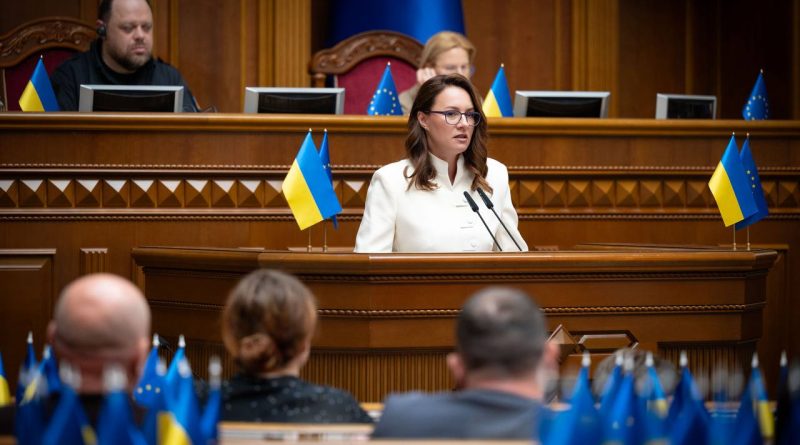
Svyrydenko Government Resigns After Less Than a Year in Office
In a significant political development, Ukraine’s parliament has voted to dismiss the Cabinet of Ministers led by First Vice Prime Minister Yulia Svyrydenko, marking an unusually brief tenure for the government that lasted less than twelve months. The vote, which took place in the Verkhovna Rada, saw 258 members of parliament supporting the motion to dismiss the cabinet, exceeding the required constitutional threshold of 226 votes needed for such a decision. This parliamentary action underscores the volatile nature of Ukrainian politics during an exceptionally challenging period in the nation’s history.
The dismissal of the Svyrydenko-led government comes at a particularly sensitive time for Ukraine, as the country continues to navigate the ongoing conflict with Russia while simultaneously managing complex economic reforms and maintaining relationships with international partners. Yulia Svyrydenko, who has served as First Vice Prime Minister and Minister of Economy, has been a key figure in Ukraine’s economic policy, overseeing efforts to stabilize the national currency, attract foreign investment, and implement reforms required by international financial institutions. Her tenure saw Ukraine continue negotiations with the International Monetary Fund and work toward meeting conditions for European Union membership candidacy.
Government reshuffles in Ukraine are not uncommon, though the speed of this particular dismissal is notable. Since gaining independence in 1991, Ukraine has experienced frequent changes in government leadership, often driven by shifting political alliances, economic pressures, and public demands for reform. The country’s parliamentary system allows for such votes of no confidence, giving legislators significant power over the executive branch. Historically, Ukrainian cabinets have averaged relatively short tenures compared to their counterparts in more stable European democracies, reflecting the dynamic and often turbulent nature of the country’s political landscape.
The decision to dismiss the government required careful political maneuvering within the Rada, where various factions and parties hold competing interests. The 258 votes in favor of dismissal suggest a broad coalition came together to support the change, potentially including members from different political camps united by concerns over government performance or policy direction. Such cross-party cooperation on major votes often signals deeper dissatisfaction with the current administration’s approach to critical issues, whether related to wartime governance, economic management, or reform implementation.
Ukraine’s wartime economy has presented unprecedented challenges for any government to manage. The country has faced massive infrastructure destruction, significant population displacement, and the need to maintain essential services while funding defense efforts. International support, including substantial aid packages from the United States, European Union, and other allies, has been crucial in keeping the Ukrainian economy functional. The dismissed government was tasked with the delicate balance of implementing necessary reforms demanded by Western partners while managing the immediate needs of a nation at war, a challenge that has tested every aspect of governmental capacity.
The political implications of this dismissal extend beyond domestic concerns, as international partners closely monitor Ukraine’s governmental stability. Western nations providing military and financial assistance often emphasize the importance of good governance, anti-corruption measures, and reform implementation as conditions for continued support. A government change, while within normal democratic processes, can create temporary uncertainty regarding policy continuity and the pace of institutional reforms that Ukraine has committed to as part of its European integration path.
Looking ahead, the parliamentary vote opens the door for the formation of a new government, a process that will require President Volodymyr Zelensky to nominate a new Prime Minister for parliamentary approval. The selection of new cabinet members will be closely watched both domestically and internationally, with attention focused on whether the new government will signal continuity or a shift in policy priorities. As Ukraine continues to face existential challenges, the composition and effectiveness of its next government will be critical in determining the country’s trajectory through the current crisis and beyond. The speed and manner of this transition will serve as an important indicator of Ukraine’s democratic resilience during one of the most difficult periods in its modern history.