Ukrainian Drone Strike Severely Damages Russian Tu-95 Strategic Bomber at Engels Airbase
A devastating Ukrainian drone strike has resulted in catastrophic damage to a Russian Tu-95 strategic bomber stationed at Engels Air Base, with satellite imagery revealing that the aircraft’s tail section was completely torn off during the attack. The Ukrainian investigative journalism project “Schemes” (Skhemy), operating in partnership with Radio Free Europe/Radio Liberty, published the satellite photographs that clearly show the extent of the destruction inflicted on one of Russia’s most prized military assets. The Security Service of Ukraine (SBU) has claimed responsibility for the operation, marking another successful long-range strike deep into Russian territory.
The Engels Air Base, located in Russia’s Saratov Oblast approximately 730 kilometers from the Ukrainian border, serves as one of the primary operational hubs for Russia’s strategic aviation forces. The facility houses a significant portion of Russia’s Tu-95MS and Tu-160 bomber fleet, aircraft that have been regularly used to launch cruise missile attacks against Ukrainian cities and critical infrastructure throughout the ongoing conflict. The successful targeting of this installation represents a significant intelligence and operational achievement for Ukrainian forces, demonstrating their growing capability to strike strategic targets well beyond the front lines.
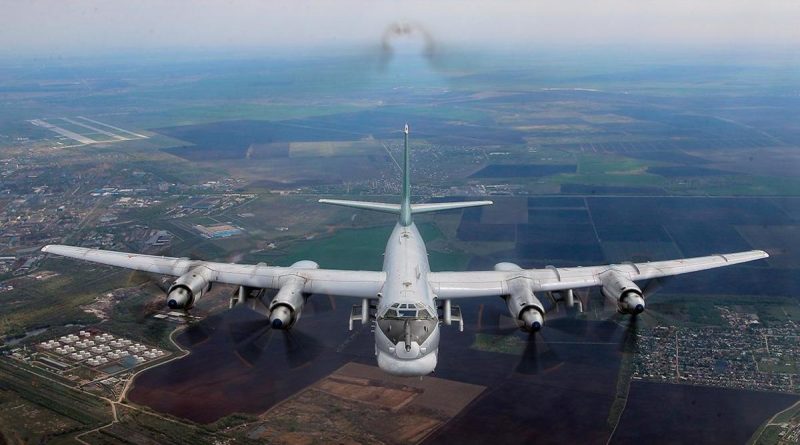
The Tu-95, NATO designation “Bear,” is a legendary aircraft that has served as the backbone of Russia’s strategic bomber force since its introduction in the 1950s. Despite its age, the turboprop-powered bomber remains a formidable weapons platform capable of carrying Kh-101 and Kh-555 cruise missiles, which have been extensively deployed against Ukraine. Each Tu-95MS can carry up to eight cruise missiles on internal rotary launchers, with modernized variants capable of carrying additional weapons on external pylons. The loss or severe damage of even a single aircraft represents a meaningful reduction in Russia’s strategic strike capabilities, as these bombers are irreplaceable assets that cannot be quickly manufactured.
This attack continues a pattern of increasingly bold Ukrainian operations targeting Russian military infrastructure far from the front lines. The Engels Air Base has been struck multiple times since the beginning of the full-scale invasion, with previous attacks in December 2022 also causing damage to aircraft stationed there. Ukrainian forces have developed and deployed domestically produced long-range drones specifically designed to reach strategic targets deep within Russia, representing a significant evolution in their military capabilities. The SBU, Ukraine’s primary security and intelligence agency, has been at the forefront of these operations, coordinating complex strikes that require extensive intelligence gathering and precise execution.
Military analysts have noted that the successful penetration of Russian air defenses to strike such a high-value target raises serious questions about the effectiveness of Russia’s layered air defense systems. Engels Air Base, given its strategic importance, would presumably be protected by multiple S-400 and Pantsir air defense systems, yet Ukrainian drones have repeatedly managed to reach their targets. This suggests either gaps in radar coverage, difficulties in detecting and tracking small, slow-flying drones, or potentially overwhelmed defense systems unable to cope with multiple simultaneous threats. The implications extend beyond this single incident, as it demonstrates vulnerabilities that could be exploited in future operations.
The strategic significance of attacks on Russia’s bomber fleet cannot be overstated. Russia possesses a limited number of strategic bombers, with estimates suggesting fewer than 60 Tu-95MS aircraft remain operational. Each successful strike that damages or destroys these aircraft permanently degrades Russia’s ability to conduct the mass cruise missile attacks that have terrorized Ukrainian civilians and damaged critical infrastructure. Furthermore, these operations force Russia to divert additional resources to air defense and may compel the relocation of valuable aircraft to bases further from Ukraine, complicating logistics and potentially reducing operational tempo.
The publication of satellite imagery confirming the damage serves multiple purposes for Ukraine, providing evidence of successful operations while simultaneously demonstrating to international partners the effectiveness of Ukrainian military capabilities. As the conflict continues into its third year, such strikes represent an important asymmetric approach that allows Ukraine to impose costs on Russia despite the significant disparity in conventional military resources. The ability to threaten strategic assets deep within Russian territory may also influence Russian calculations about the costs and benefits of continuing offensive operations, adding a new dimension to the ongoing conflict that extends far beyond the traditional battlefield.