
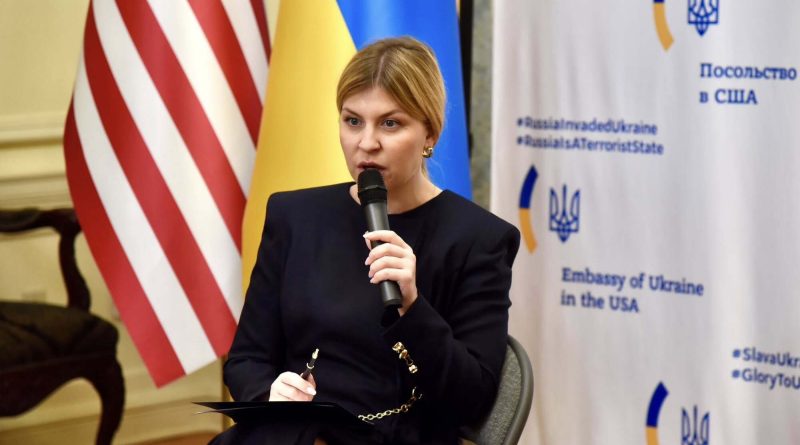
“We Can Pay for This”: Stefanishyna Explains Zelensky’s Urgent Letter to Trump
Ukraine’s Deputy Prime Minister for European and Euro-Atlantic Integration, Olga Stefanishyna, has shed light on the reasoning behind President Volodymyr Zelensky’s recent urgent letter to U.S. President Donald Trump. According to the Ukrainian diplomat, the correspondence reflects Kyiv’s desperate efforts to negotiate with Washington regarding Ukraine’s capability to intercept ballistic missiles, a critical component of the country’s defense infrastructure as the war with Russia continues to intensify.
The revelation comes at a pivotal moment in the ongoing conflict, as Ukraine faces increasingly sophisticated aerial attacks from Russian forces. Stefanishyna emphasized that Ukraine is not merely seeking charity from its Western allies but is prepared to contribute financially to securing advanced air defense systems. “We can pay for this,” she stated, underscoring Kyiv’s commitment to taking ownership of its defense needs while still requiring technological and logistical support from the United States.
The urgency of Zelensky’s communication reflects the stark reality on the ground. Since Russia began its full-scale invasion in February 2022, Ukraine has faced relentless missile and drone attacks targeting its civilian infrastructure, energy facilities, and population centers. Russian forces have deployed a variety of weapons including Iskander ballistic missiles, Kalibr cruise missiles, and Iranian-made Shahed drones. The ability to intercept ballistic missiles, which travel at hypersonic speeds and follow unpredictable trajectories, requires sophisticated systems like the American Patriot or Israeli Iron Dome, technologies that remain in limited supply within Ukraine’s arsenal.
The diplomatic push for enhanced air defense capabilities comes against the backdrop of shifting political dynamics in Washington. President Trump’s return to office has introduced uncertainty regarding the future of American military aid to Ukraine. During his campaign, Trump repeatedly expressed skepticism about continued support for Kyiv and suggested he could negotiate a quick end to the conflict. Ukrainian officials have been working to adapt their approach, emphasizing economic partnerships and mutual benefits rather than purely humanitarian appeals, a strategy that aligns with Trump’s transactional approach to foreign policy.
Historically, Ukraine’s air defense network was built around Soviet-era systems like the S-300, which have proven partially effective but are increasingly outdated against modern Russian weaponry. The integration of Western systems has been gradual and complex, requiring extensive training for Ukrainian operators and establishing supply chains for ammunition and spare parts. Countries including Germany, the Netherlands, and the United States have provided Patriot batteries, while other NATO members have contributed IRIS-T and NASAMS systems. However, experts estimate that Ukraine would need significantly more coverage to adequately protect its major cities and critical infrastructure.
Military analysts suggest that Ukraine’s willingness to pay for defense systems could reshape the dynamics of Western military assistance. Unlike previous aid packages that came as grants or loans, a commercial arrangement might expedite delivery and reduce political obstacles in donor countries. Dr. Michael Kofman, a defense analyst specializing in Russian military affairs, has previously noted that Ukraine’s most pressing need remains integrated air and missile defense, particularly against ballistic threats that can overwhelm point-defense systems designed for slower-moving targets.
The timing of Stefanishyna’s remarks also coincides with ongoing discussions about potential ceasefire negotiations and the future shape of any peace agreement. Ukrainian officials have consistently maintained that any diplomatic resolution must include robust security guarantees, with advanced air defense being a cornerstone of the country’s post-war deterrence strategy. Zelensky has repeatedly stated that Ukraine cannot accept a peace that leaves it vulnerable to future aggression, making the acquisition of modern defense technology not just a wartime necessity but a long-term strategic imperative.
As winter approaches and Russia historically intensifies its attacks on Ukrainian energy infrastructure, the pressure on Kyiv to secure additional defensive capabilities grows more acute. The urgent letter to Trump represents Ukraine’s latest effort to navigate the complex geopolitical landscape while ensuring its survival against a militarily superior adversary. Whether Washington will respond favorably to Zelensky’s appeal remains to be seen, but Ukraine’s message is clear: it is willing to be a partner, not just a recipient, in securing its own defense.