
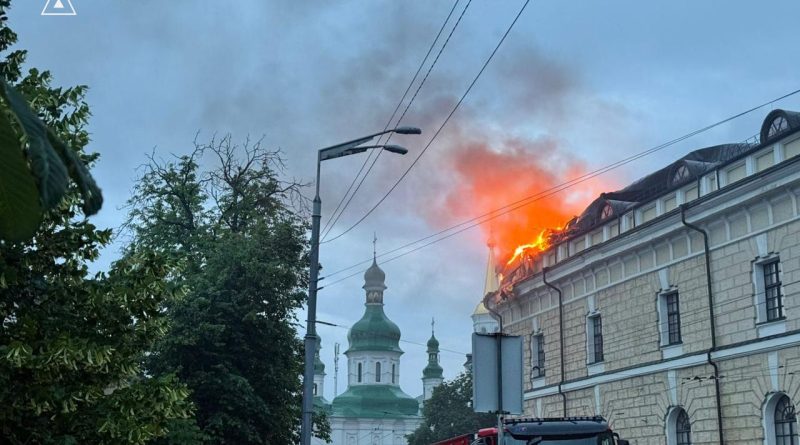
“He Must Be Cursed and Will Lose This War”: Global Outrage Over Russian Strike on Kyiv-Pechersk Lavra
The international community has erupted in condemnation following a Russian missile strike on the Kyiv-Pechersk Lavra, one of the most sacred Orthodox Christian sites in the world and a UNESCO World Heritage landmark. Ukraine has issued an urgent appeal to UNESCO demanding an immediate response to what officials describe as a deliberate attack on irreplaceable cultural and religious heritage. The strike has intensified global criticism of Russia’s military campaign and raised serious questions about the protection of cultural sites during armed conflict.
The Kyiv-Pechersk Lavra, also known as the Monastery of the Caves, stands as one of Eastern Europe’s most significant spiritual and historical monuments. Founded in 1051 during the reign of Yaroslav the Wise, the monastery complex has served as a center of Orthodox Christianity for nearly a millennium. The site includes ancient cave systems where monks lived and prayed, golden-domed cathedrals, and priceless religious artifacts that trace the spiritual development of the region. UNESCO inscribed the Lavra on its World Heritage List in 1990, recognizing its outstanding universal value to humanity.
Ukrainian officials reacted with fury to the attack, with President Volodymyr Zelensky and other government representatives issuing strong statements condemning Russia’s actions. The Ukrainian Ministry of Culture immediately contacted UNESCO headquarters in Paris, demanding that the international organization take concrete steps to hold Russia accountable for targeting protected cultural heritage. Ukrainian diplomats emphasized that the strike represents not just an attack on Ukraine, but an assault on shared human civilization and religious tradition that transcends national boundaries.
European leaders joined the chorus of condemnation, with several heads of state and foreign ministers expressing shock and outrage over the targeting of such a significant religious site. Many officials pointed to the strike as further evidence that Russia’s military campaign shows no regard for international humanitarian law or the protection of civilian and cultural sites. The European Union has consistently supported Ukraine’s efforts to document and preserve evidence of cultural heritage destruction for potential future legal proceedings.
The reaction from the United States was equally forceful, with State Department officials and members of Congress denouncing the attack in stark terms. Some American officials declared that Russian President Vladimir Putin “must be cursed and will lose this war,” reflecting the increasingly personal nature of Western criticism directed at Russia’s leadership. The U.S. has been tracking Russian strikes on Ukrainian cultural sites as part of broader documentation efforts related to potential war crimes investigations.
The targeting of religious and cultural sites during armed conflict violates multiple international conventions, including the 1954 Hague Convention for the Protection of Cultural Property in the Event of Armed Conflict. Russia, as a signatory to these agreements, faces potential legal consequences for attacks on protected heritage sites. International criminal law experts note that deliberate destruction of cultural property can constitute a war crime under the Rome Statute of the International Criminal Court, adding another potential charge to the growing list of alleged Russian violations.
This latest strike fits a disturbing pattern of Russian attacks on Ukrainian cultural heritage that has been documented throughout the conflict. Since February 2022, hundreds of museums, churches, monuments, and historical buildings across Ukraine have suffered damage or destruction. UNESCO has been working with Ukrainian authorities to assess damage and provide emergency assistance for heritage preservation, though the organization’s ability to prevent such attacks remains limited. The international community continues to grapple with how to effectively protect irreplaceable cultural treasures in active war zones, even as Ukraine calls for stronger mechanisms to hold perpetrators accountable.