Russia Cynically Claims Lavra Attack Was ‘Response to Terrorist Attacks’ by Kyiv
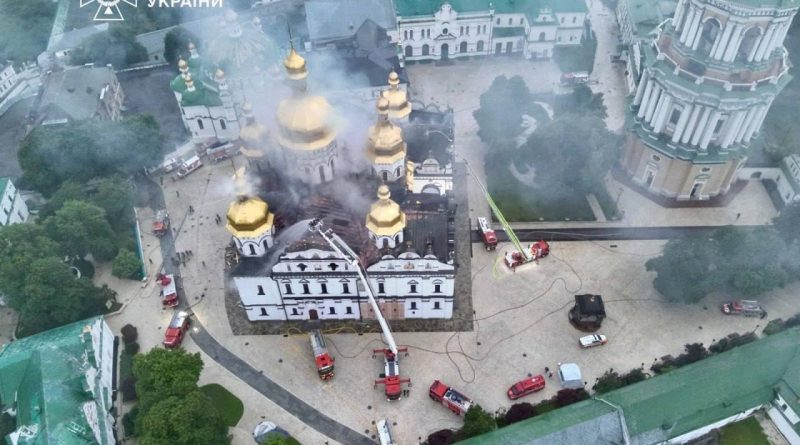
In a brazen display of propaganda following the devastating strike on the Kyiv-Pechersk Lavra, Russian officials have attempted to justify the attack by claiming it was a response to alleged Ukrainian ‘terrorist attacks’ on Russian territory. The Russian Defense Ministry released a statement asserting that their missiles had ‘achieved their objectives,’ claiming targets included Ukrainian airfields and territorial recruitment centers. However, the reality on the ground tells a starkly different story, as one of UNESCO’s most sacred World Heritage Sites now bears the scars of Russian aggression.
The Kyiv-Pechersk Lavra, also known as the Monastery of the Caves, stands as one of the most significant spiritual and cultural landmarks in Eastern European Christianity. Founded in 1051 during the reign of Yaroslav the Wise, this ancient monastery complex has survived nearly a millennium of history, including Mongol invasions, wars, and Soviet persecution. The complex houses irreplaceable religious artifacts, ancient frescoes, and the remains of saints venerated by Orthodox Christians worldwide. Its golden domes have symbolized Kyiv’s spiritual identity for generations, making the attack not merely a military strike but an assault on Ukrainian cultural heritage.
International observers and military analysts have quickly dismissed Russia’s justification as a transparent attempt to deflect responsibility for what appears to be a deliberate attack on civilian and cultural infrastructure. The claim that the strike targeted military installations rings hollow when satellite imagery and ground reports confirm damage to religious structures. This pattern of attacking cultural sites while claiming military necessity has become a disturbing hallmark of Russia’s campaign in Ukraine, with previous strikes damaging theaters, museums, and churches across the country.
The cynicism of Moscow’s response has drawn sharp condemnation from world leaders and international organizations. UNESCO Director-General Audrey Azoulay has repeatedly warned that attacks on cultural heritage sites constitute war crimes under international humanitarian law, specifically the 1954 Hague Convention for the Protection of Cultural Property in the Event of Armed Conflict. Russia, as a signatory to this convention, has legal obligations to protect such sites, making the attack and subsequent justification particularly egregious in the eyes of the international community.
Ukrainian President Volodymyr Zelensky condemned the attack in the strongest terms, calling it evidence of Russia’s ‘terror state’ tactics. Ukrainian officials have documented extensive damage to the monastery complex, including structural damage to historic buildings and destruction of artifacts that had survived centuries of turmoil. Emergency restoration teams have been deployed to assess the full extent of the damage, though experts warn that some losses may be irreparable. The attack has galvanized international support for enhanced protection of Ukraine’s cultural sites, with several nations pledging additional funding for heritage preservation efforts.
Military experts note that Russia’s pattern of attacking civilian infrastructure while claiming military targets follows a well-documented strategy of psychological warfare and terror. By striking at the heart of Ukrainian identity and spirituality, Moscow appears to be attempting to break the will of the Ukrainian people. However, historical precedent suggests such tactics often backfire, strengthening rather than weakening national resolve. The bombing of cultural sites during World War II, for instance, frequently served to unite populations against aggressors rather than demoralize them.
The international response to the Lavra attack has been swift and unequivocal. European Union officials have called for additional sanctions against those responsible for ordering strikes on protected cultural sites. Human rights organizations are documenting the incident as potential evidence for future war crimes prosecutions at the International Criminal Court. Meanwhile, religious leaders from multiple faiths have united in condemning the attack, with the Ecumenical Patriarch of Constantinople calling it ‘an offense against all of Christianity.’ As Ukraine continues to defend its sovereignty, the attack on the Lavra serves as a stark reminder of what is at stake in this conflict – not merely territory, but the preservation of a nation’s soul and heritage.