
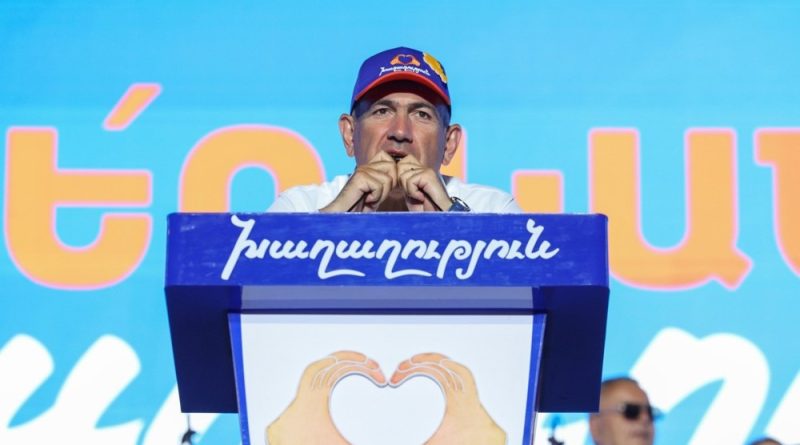
Exit Polls Show Conflicting Results in Armenian Parliamentary Elections as Pashinyan Claims Victory
Armenia’s snap parliamentary elections have produced dramatically conflicting exit poll results, with surveys commissioned by rival political camps showing completely opposite outcomes. The elections, held on Sunday, have become a crucial test for Prime Minister Nikol Pashinyan’s Civil Contract party following years of political turbulence and the devastating aftermath of the 2020 Nagorno-Karabakh war that reshaped the country’s political landscape.
According to an exit poll conducted by the Gallup International Association and commissioned by pro-government media outlets, Pashinyan’s Civil Contract party secured a commanding victory with approximately 54% of the vote. This result would give the ruling party a comfortable parliamentary majority and allow Pashinyan to continue his reform agenda without coalition partners. The same poll showed opposition forces trailing significantly, with no other party approaching the threshold needed to seriously challenge the incumbent government’s dominance.
However, a starkly different picture emerged from an exit poll conducted on behalf of opposition-aligned media. This survey suggested that opposition forces had actually outperformed the ruling party, potentially setting the stage for a dramatic political shift in the South Caucasus nation. The contradictory results have raised concerns about polling methodology and the deeply polarized nature of Armenian politics, where media organizations often align closely with political factions and produce coverage that reflects their partisan affiliations.
The political context surrounding these elections cannot be understated. Armenia has experienced profound upheaval since the 2018 Velvet Revolution, which brought Pashinyan to power on a wave of anti-corruption sentiment and promises of democratic reform. The former journalist and opposition activist initially enjoyed widespread popular support, positioning himself as a break from the country’s post-Soviet political establishment that had governed Armenia for decades. His early tenure saw genuine progress on transparency initiatives and efforts to combat endemic corruption.
The situation changed dramatically following the 2020 war with Azerbaijan over the disputed Nagorno-Karabakh region. The 44-day conflict ended in a devastating defeat for Armenian forces, with Azerbaijan recapturing significant territories that had been under Armenian control since the 1990s. The ceasefire agreement, brokered by Russia, required Armenia to withdraw from several districts surrounding the former autonomous region. This military setback triggered massive protests in Yerevan, with opposition figures and veterans demanding Pashinyan’s resignation and accusing him of betraying national interests.
The complete loss of Nagorno-Karabakh in September 2023, when Azerbaijan launched a lightning military operation that resulted in the exodus of over 100,000 ethnic Armenians from the region, further complicated Pashinyan’s political position. Critics argue that his government failed to adequately prepare for the defense of the Armenian population and was diplomatically outmaneuvered by Baku. Supporters counter that Pashinyan inherited an untenable military situation and that previous governments bear responsibility for the frozen conflict’s eventual resolution through force.
International observers have been monitoring the electoral process closely, with particular attention to media freedom, campaign financing, and the conduct of voting procedures. Armenia has made significant strides in electoral transparency compared to previous decades, though concerns remain about the influence of oligarchic structures and the polarized information environment. The European Union and United States have both emphasized the importance of free and fair elections for Armenia’s democratic trajectory and its ongoing efforts to integrate with Western institutions while managing complex relationships with Russia and regional powers.
As official results are tabulated by the Central Election Commission, both the ruling party and opposition forces have expressed confidence in their electoral prospects. The significant discrepancy between exit polls suggests that the coming hours and days will be critical in determining whether Armenia faces a smooth transition or potential political crisis. Regardless of the final outcome, these elections represent a pivotal moment for a nation navigating between its Soviet past, regional security challenges, and aspirations for democratic consolidation and economic development in an increasingly volatile geopolitical environment.