
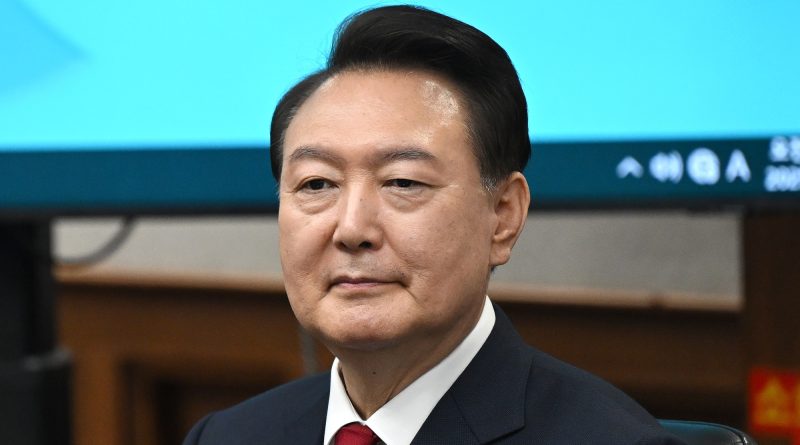
Former South Korean President Yoon Receives Additional 30-Year Prison Sentence in Martial Law Case
In a landmark ruling that has sent shockwaves through South Korean politics, former President Yoon Suk-yeol has been sentenced to an additional 30 years in prison after being found guilty of aiding the enemy and abuse of power. The verdict, delivered by the Seoul Central District Court, represents one of the most severe punishments ever handed down to a former head of state in the nation’s history and marks a dramatic fall from grace for the conservative leader who rose to power promising to uphold law and order.
The charges stem from Yoon’s controversial declaration of martial law in December 2024, a move that plunged the country into political chaos and drew immediate condemnation from lawmakers, civil society groups, and international observers. Prosecutors argued that by deploying military forces to suppress civilian government functions and potentially undermining national security protocols, Yoon effectively aided hostile foreign interests and betrayed his constitutional oath of office. The court agreed with this assessment, finding substantial evidence that the former president exceeded his executive authority in ways that endangered the republic.
The martial law declaration, which lasted only a matter of hours before being overturned by the National Assembly in an emergency session, nonetheless left an indelible mark on South Korean democracy. Soldiers were deployed to the National Assembly building, and there were tense standoffs as lawmakers physically pushed past military personnel to cast their votes against the emergency measure. The incident evoked painful memories of South Korea’s authoritarian past, when military governments ruled the country for decades following the Korean War. For many South Koreans, particularly those who lived through the pro-democracy movements of the 1980s, Yoon’s actions represented an unthinkable regression.
South Korea’s turbulent political history provides important context for understanding the severity of the court’s ruling. The country transitioned to democracy in 1987 after years of military dictatorship, and the memory of authoritarian rule remains fresh in the national consciousness. Two former presidents, Chun Doo-hwan and Roh Tae-woo, were previously convicted of mutiny and treason for their roles in the 1979 military coup and the subsequent Gwangju Massacre, though both were later pardoned. More recently, former President Park Geun-hye was impeached and imprisoned on corruption charges in 2017, serving nearly five years before receiving a presidential pardon. Yoon’s case, however, stands apart due to the direct nature of his alleged assault on democratic institutions.
Legal experts and political analysts have noted that the 30-year sentence, combined with any previous or concurrent penalties, effectively ensures that the 64-year-old former president will spend the remainder of his life behind bars unless he receives executive clemency. Constitutional law professor Kim Sung-ho of Seoul National University commented that the verdict reflects the judiciary’s determination to send an unambiguous message that attempts to subvert democracy will not be tolerated, regardless of the perpetrator’s former position. International human rights organizations have been monitoring the proceedings closely, with some expressing concern about the political dimensions of the case while others have praised South Korea’s commitment to holding powerful figures accountable.
The implications of this ruling extend far beyond Yoon’s personal fate. South Korea’s political landscape has been fundamentally reshaped by the martial law crisis and its aftermath. The conservative People Power Party, which Yoon once led, has struggled to distance itself from the scandal while maintaining its policy positions. Meanwhile, opposition parties have capitalized on public outrage to push for constitutional reforms aimed at strengthening legislative oversight of executive power and clarifying the circumstances under which emergency measures may be invoked. Public opinion polls indicate that a significant majority of South Koreans support the court’s decision, viewing it as a necessary affirmation of democratic principles.
As Yoon’s legal team announced plans to appeal the verdict, questions remain about the long-term impact on South Korean society and its democratic institutions. The case has sparked renewed debate about the concentration of power in the presidency, the role of the military in civilian affairs, and the mechanisms available to prevent future constitutional crises. For now, the ruling stands as a powerful reminder that in modern South Korea, no individual—not even a former president—is above the law. The nation watches closely as this unprecedented chapter in its democratic history continues to unfold, with the appeals process expected to take months if not years to resolve.